

Rivet
A rivet is a permanent mechanical fastener used to join two or more materials securely. It typically consists of a smooth cylindrical shaft with a head on one end.
Basic Structure & Function
Head: The pre-formed end that provides a bearing surface.
Shank: The main body inserted through pre-drilled holes in the workpieces.
Tail: The end that is deformed (buckled or flattened) during installation to lock the joint.
Once installed, the deformed tail creates a second head, clamping the materials tightly together. Rivets form rigid, non‑removable joints that resist shear, tension, and vibration.
Common Types
Solid rivets: Traditional, strong, used in heavy machinery, bridges, and steel structures.
Blind rivets (pop rivets): Installed from one side only, widely used in sheet metal, automotive, and construction.
Tubular / semi-tubular rivets: Lightweight, common in clothing, leather goods, and electronics.
Drive rivets: Quick-install, used for light-duty assembly.
Applications
Rivets are widely used in aerospace, aviation, ships, railways, bridges, buildings, automotive manufacturing, luggage, and metal fabrication due to their high reliability and durability.

Nut
A nut is a fastener with a threaded hole, almost always used in conjunction with a matching bolt to assemble and secure multiple components together.
Working Principle
The internal thread of the nut engages with the external thread of the bolt. By rotating the nut, it moves along the bolt shaft, creating clamping force that holds parts tightly and prevents loosening under vibration or load.
Common Types
Hex nut: The most widely used, with six flat sides for easy wrench tightening.
Lock nut: Designed to resist loosening, often used in automotive and machinery.
Wing nut: Has wing-like projections for hand tightening without tools.
Cap nut: Covers the bolt end for safety and appearance.
Flange nut: Features an integrated flange to distribute pressure and act as a washer.
Applications
Nuts are essential in construction, machinery, automotive, electronics, furniture, and aerospace. They provide strong, removable joints and are one of the most common mechanical fasteners worldwide.

Screw
A screw is a threaded fastener characterized by a helical ridge wrapped around a cylindrical or conical shaft. It is one of the most widely used mechanical fasteners.
Structure & Principle
A typical screw consists of a head (for driving), a shank, and external threads. Unlike bolts, many screws can be driven directly into materials such as metal, plastic, wood, or concrete, creating their own mating threads or cutting into the material.
Key Features
Forms a removable or semi‑permanent joint
Transmits rotational force into linear clamping force
High resistance to loosening under vibration
Can be installed with or without a nut
Common Types
Wood screw: For joining wooden components.
Sheet metal screw: Used in thin metal sheets.
Self‑tapping screw: Creates its own thread when inserted.
Machine screw: Small, precise, used with a nut or tapped hole.
Drywall screw: Designed for plasterboard and light construction.
Applications
Screws are extensively used in furniture, electronics, construction, automotive, household appliances, and general assembly due to their convenience, versatility, and ease of installation.

Long screw & Bolt
Long bolts and long screws are elongated threaded fasteners with extended shanks, designed to connect thick components, assemble long‑span structures, or reach deep mounting positions.
Long Bolt
A long bolt is an extended version of a standard bolt, usually with a full or partial threaded shaft and a hexagonal head. It is used with a matching nut to clamp multiple layers or thick workpieces tightly. Long bolts provide high tensile strength and stability, and are widely applied in steel structures, towers, machinery bases, pipeline brackets, and large equipment assembly.
Long Screw
A long screw features an extended threaded body and can be driven directly into pre‑tapped holes or self‑tapped into materials such as wood, plastic, and sheet metal. Compared with long bolts, it is more convenient for single‑sided installation. Long screws are commonly used in furniture assembly, decoration, electrical enclosures, and mechanical components that require deep fastening.
Common Features
Extended length for deep or multi‑layer assembly
High rigidity and load‑bearing capacity
Removable and reusable connections
Good resistance to vibration and loosening
Applications
Long bolts and screws are widely used in construction engineering, mechanical equipment, furniture manufacturing, automotive engineering, power facilities, and various industrial assembly scenarios where standard‑length fasteners cannot meet the fastening depth.


Stainless steel screws
A stainless steel bolt is a high-performance threaded fastener made from stainless steel alloy, widely used for its excellent corrosion resistance and durability.
Key Features
Corrosion resistance: Contains chromium and other alloying elements, providing strong protection against rust, oxidation, moisture, and mild chemicals.
High strength & stability: Maintains mechanical properties in various temperatures and harsh environments.
Hygienic & aesthetic: Clean surface, non‑toxic, and suitable for visible or hygiene‑sensitive applications.
Long service life: Resists wear, fatigue, and degradation better than carbon steel bolts in demanding conditions.
Common Grades
A2‑70 (304 stainless steel): General‑purpose, good corrosion resistance, used in most indoor and outdoor applications.
A4‑80 (316 stainless steel): Marine‑grade, highly resistant to saltwater, chemicals, and severe outdoor environments.
Applications
Stainless steel bolts are widely used in marine equipment, construction, outdoor structures, food processing machinery, medical devices, automotive parts, and coastal engineering. They are ideal for environments where rust prevention and reliability are critical.


Pin
Main Functions
Positioning and alignment of parts
Securing components against relative movement
Transmitting light torque or shear force
Locking bolts, shafts, or other fasteners
Common Types
Cotter pin: Used with slotted nuts to prevent loosening, widely in machinery and vehicles.
Straight pin / Dowel pin: Precision cylindrical pin for accurate positioning.
Taper pin: Tapered shape for firm fitting and easy assembly.
Spring pin: Elastic cylindrical pin, shock‑resistant and convenient to install.
Roll pin: Hollow coiled pin, used for light‑to‑medium load connections.
Features
Simple structure, small size, low cost
High shear resistance
Easy to assemble and disassemble
Stable performance under vibration
Applications
Pins are commonly used in machinery, automobiles, motorcycles, furniture, aerospace, instrumentation, and various assembly structures requiring positioning or anti‑loosening locking.
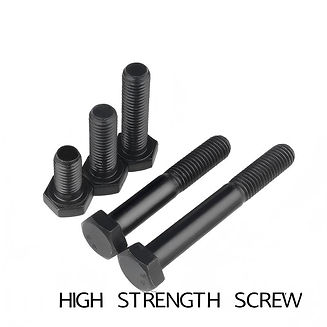
High Strength Screw
High-strength bolts are heavy-duty threaded fasteners manufactured from alloy steel through specialized heat treatment, featuring much higher tensile strength, yield strength, and clamping force than ordinary bolts.
Key Characteristics
High mechanical performance: Made from high‑strength alloy steel with quenching and tempering, providing excellent tensile and shear resistance.
Large pre‑tightening force: Installed with controlled torque to generate strong clamping force, effectively preventing relative slip between connected parts.
Good anti‑loosening performance: Stable under heavy loads, vibration, and impact, widely used in structural connections.
High dimensional accuracy: Strictly controlled dimensions to ensure reliable fitting and uniform stress distribution.
Common Grades
Common performance grades include 8.8, 10.9, 12.9, representing different levels of tensile strength and hardness.
Applications
High-strength bolts are mainly used in steel structure buildings, bridges, towers, rail transit, heavy machinery, automotive chassis, wind power equipment, and other fields requiring safe and rigid structural connections.